
CRG Defense, a U.S.-based manufacturer of advanced battery cells, packs, motors, and propulsion systems, is positioned to meet surging demand from defense and commercial drone manufacturers facing new federal sourcing restrictions. With the FCC’s December 2025 ban on foreign-produced UAS critical components and Section 842 of the FY 2026 NDAA prohibiting DoD procurement of batteries from foreign entities of concern, CRG Defense offers fully compliant, domestically-manufactured energy and propulsion solutions designed for the new regulatory environment.
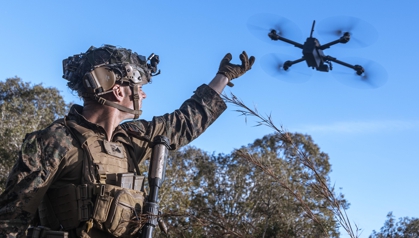
Credit: Marine Corps Lance Cpl. Victor Gurrola
FCC Restrictions on Foreign-Produced UAS and Critical Components
On December 22, 2025, the Federal Communications Commission (FCC) added all foreign-produced uncrewed aircraft systems (UAS) and UAS critical components to its Covered List, following a National Security Determination issued December 21, 2025. This action prohibits new FCC equipment authorizations for foreign-produced UAS equipment to mitigate risks including direct UAS attacks, disruption at major events including World Cup and Olympic venues, unauthorized surveillance, and sensitive data exfiltration.
UAS critical components explicitly include batteries, battery management systems, and motors—core CRG Defense capabilities—alongside communications systems, flight controllers, navigation systems, sensors, cameras, and associated software. Equipment in these categories produced abroad cannot receive new FCC equipment authorizations. All applicants must certify their systems are not on the Covered List before approvals are granted, creating immediate compliance pressure for OEMs relying on foreign supply chains.
The FY 2026 NDAA Section 842 reinforces this shift by prohibiting the Department of Defense from procuring advanced batteries and cells whose functional cell components or technology are owned, sourced, refined, or produced by a foreign entity of concern (FEOC). This requirement applies to new acquisition programs beginning January 1, 2028, standard batteries on January 1, 2029, and existing acquisition programs on January 1, 2031.
Market Impact and CRG Defense Response
These actions jointly push U.S. drone and warfighting system manufacturers to transition away from foreign-produced battery and electric motor supply chains. Program offices, primes, and key suppliers will need domestically produced batteries and propulsion components to ensure compliance with new federal requirements. With FCC restrictions already in effect and NDAA compliance deadlines approaching, the window for supply chain restructuring is narrow. Early adopters of compliant domestic sources will maintain program continuity and competitive advantage in federal contracting.
“The shift to domestic sourcing for critical UAS components represents both a challenge and an opportunity for the defense industrial base,” said Patrick Hood, CEO of CRG Defense. “We’ve invested in domestic manufacturing capabilities specifically to support mission-critical programs that require secure, compliant supply chains. Our customers can transition with confidence knowing they’re working with a proven U.S. manufacturer.”
CRG Defense manufactures advanced battery cells, battery packs, motors, and propulsion systems at its U.S. facilities, delivering UAS critical components fully compliant with FCC Covered List requirements and NDAA Section 842. The company’s domestic production capabilities address the immediate needs of OEMs, prime contractors, and system integrators facing equipment authorization barriers and DoD procurement restrictions. CRG Defense’s solutions support both defense and commercial platforms, providing the secure, traceable supply chain required for programs under current and future federal sourcing mandates. CRG Defense is committed to supporting the U.S. defense industrial base with domestically manufactured critical components that meet evolving federal sourcing and security requirements.
For more information about CRG Defense’s compliant battery and propulsion solutions, Contact Us